
Over the years, application programming interfaces (API) have enabled communication between different solutions and systems. However, it is worth noting that companies are increasingly paying attention to these commonly overlooked technologies and opening up another function: through the development of technical assets, to realize the reuse of these assets within the enterprise or even outside the enterprise.
Reuse not only improves the return on investment of information technology, but also lays the foundation for API users to take creative ways to use existing data, transactions, and products. With the increasing momentum of API applications, companies have begun to explore new ways to expose, manage and control APIs.
As this trend will increase in the next few months, for this traditional technology that plays a key pillar in achieving digital goals, it is expected that further innovative methods will appear in its contract, pricing, service and even marketing management.
Looking back at the history of the industrial revolution, interoperability and modularity have always brought competitive advantages. The concept of interchangeable parts proposed by Eli Henry was replaced by the assembly line invented by Henry Ford, which ushered in the era of mass production.
Related Articles
- 10 Trends of IoT Communications Development in 2021
- 2021 Top Rated Unified Security Management Software
- 2021 Mobile App Development Trends and Technologies
- WeTransfer App Pro Alternatives – Plus Websites 2020/2021
- 10 Predictions for Information Data Centre and the Cloud in 2021
Sabre has revolutionized the aviation industry by regulating the booking and ticketing process, thereby promoting unprecedented mutual collaboration. The payment network simplifies the global banking business, among which SWIFT and FIX become the basis of financial transactions, which in turn promotes the rapid development of trade and commerce.
In the digital age, the same concept is reflected in the “platform”-the value of the solution lies not only in the ability to solve current business problems, but also in the ability to build a platform for future growth. In this regard, we might as well take a look at the core services of global digital giants, including Alibaba, Alphabet, Apple, Amazon, Facebook, Microsoft, Tencent and Baidu.
These companies extend the scope of services to the entire ecosystem including end users, third parties and other parties by providing platforms for customers, thereby gaining a dominant position in certain areas. These platforms are based on the principles of interoperability and modularity. Designed.
In the field of information technology, API is one of the key elements to support interoperability and design modularity. As an architecture technology, API has a long history and computer science. It can improve the way of exchanging information, calling business logic and executing transaction processing between systems and solutions. It has gradually become a strategic task.
Technology Trends
The “Technology Trends” released in recent years pointed out that the number of API deployments is increasing and that it is playing an increasingly important role in the system architecture, innovation, modernization, and the booming “API economy”.
Moreover, this growth is still in rapid progress: as of the beginning of 2017, the number of available public APIs has exceeded 18,000, an increase of approximately 2,000 year-on-year. Looking at the world’s large enterprises, the number of private APIs may have reached millions. API can bring a variety of operational and strategic value to enterprises.
Using modern APIs to inject vitality into the legacy system can “encapsulate” the intellectual property and data contained in the system, allowing new developers to reuse this information. Similarly, building APIs on legacy systems can extract more value from information technology assets and use existing data to drive innovation.
In addition, combining APIs with new applications can make it easier to consume and reuse data in new web, mobile, and IoT experiences, not to mention exposing APIs to the outside to drive new business models and partner ecosystems.
API Logic Architecture
The basic API logic architecture provides a blueprint for implementing API strategies, designing and deploying APIs, and ultimately maximizing value (see the figure below). To avoid over-designing the API architecture, consider designing based on existing corporate functional areas (such as marketing, finance, or HR), and then map the API to the services that each area may provide.
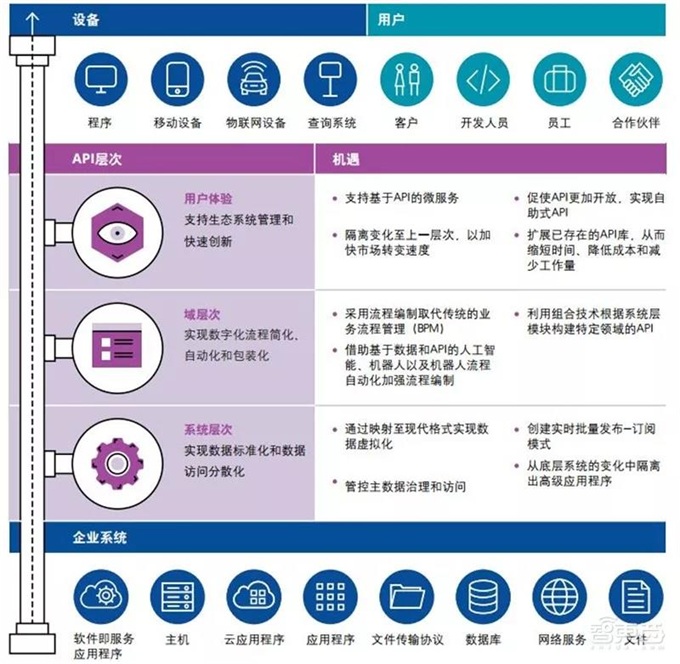
If every company is a technology company, then there will be an intuitive idea that technology assets should be reused. The reuse of assets requires companies to have new capabilities, that is, to manage the exchange of “encapsulated” intellectual property rights.
These new capabilities can also support the flow of information and business operations between organizations, as well as manage the discovery, use, and maintenance of API assets. On the whole, the strategic intent of the API and potential support responses reflect the imperative of API applications-strategic deployment of APIs to promote the self-service release and use of services inside and outside the enterprise.
APIs improve the way we implement, interact and experience enterprise solutions
1. Hybrid information technology infrastructure
The hybrid infrastructure consists of a combination of on-premises data centers, private clouds, and/or public clouds. For most companies with local technology investments, the adoption of a hybrid architecture is a necessary condition for cloud technology applications. Especially for companies that have been running for several years, it is very rare to rely entirely on local or completely use cloud technology.
In the process of transforming traditional IT organizations to cloud technology, existing data centers still need continuous support. This balance of cost, flexibility, control, risk, and security has prompted many companies to adopt a hybrid information technology strategy. Enterprises will increasingly live in a hybrid world, with some applications in the public cloud and the other in the data center.
The environment in which enterprise systems and applications are deployed depends on strategic business requirements, tactical requirements, and goals. Today’s enterprises must have an integrated strategy that can seamlessly integrate any applications and systems deployed on local, public cloud, hybrid cloud infrastructure, or private cloud. API is the key enabler for integrating these infrastructure platforms.
2. Operational transformation
The emergence of APIs has prompted companies to transform from daily information technology operations to a way of interacting with customers. Enterprises are gradually realizing the effects of digital transformation. Since API can perform part of the management and maintenance affairs independently, the information technology department can invest talents in more innovative activities.
By embedding decision science and machine learning directly into business processes, business leaders can focus on managing business results instead of dealing with new technologies. Simplify customer engagement activities while providing instant and valuable data insights for their business. In the end, API can stimulate cultural changes in many enterprises by realizing the integration of multiple information technology systems, building a more collaborative and self-service IT environment, and deriving benefits from existing information technology assets.
3. Autonomous platform
The autonomous platform has scalability, self-monitoring, autonomous learning and self-repair functions, which can continuously meet the needs of automation. As more and more information technology can be expressed in code—from the underlying infrastructure to the tasks of the information technology department—companies now have the opportunity to apply new architectural patterns and principles.
Taking this opportunity, companies can eliminate the dependence between business results and basic solutions, and at the same time redistribute information technology talents engaged in repetitive low-value tasks to higher-level jobs.
Using autonomous APIs, it can provide a data warehouse in a few seconds to a few minutes, use intelligent data analysis to populate the data catalog, and automatically analyze important findings through visualization and narration.
With the increasing popularity of machine learning and crowdsourcing APIs, companies need to prioritize their integration into information technology. This unprecedented freedom and automation of the cloud will affect the daily lives of users.
4. Microservices and application integration
Large enterprises usually deploy thousands of applications to support business operations. More and more companies disassemble systems through the deployment of microservices and rebuild them into the incarnation of independent business rules.
The emergence of microservices and the success of the core revival program have spawned a completely different set of software design methods, the core components of which are no longer interdependent or integrated, but “loosely coupled”. Microservices disassemble larger applications into small, modular, independently deployable services, and communicate through APIs.
This approach creates a modern application architecture and further promotes the development of the API economy. API and microservice platforms provide a DevOps experience that truly meets the speed and scalability requirements by realizing automated continuous integration/delivery processes.
5. API-driven digital transformation
For companies in transition, speed is critical. In many cases, it is not enough to rely on individual digital assets of a company. It is necessary to use and combine the technical assets of other companies in interesting and novel ways. Therefore, various platforms have been born under the network effect of API.
API is promoting digital transformation across industries and markets. Companies are using APIs to expand their business functions through partners, customers, and other ecosystem channels. This is true for both B2B and B2C markets. Web-API is paving the way for expanding market coverage and acquiring new customers through multiple channels (mainly social and mobile applications).
Many cloud service providers are shifting their focus from traditional profit-making methods to demonstrating key capabilities of their digital business. Especially with the digitization of many products and services realized by big data platforms and the Internet of Things, the influence of APIs far exceeds the scope of technology companies.
Pioneer companies leading the API trend have found that sharing technology assets makes more profit than controlling technology assets. Fully accepting this trend requires companies to reconsider the development, integration, and governance methods that they have consistently adopted for a long time. Also, sticking to the old rules is no longer feasible. The transformation from an independent system to an API platform has kicked off, take the lead in sharing and benefit first.
Keep Reading
- Microsoft Cloud Services Improve the Quality of Life in China
- China’s Cloud Computing Industry is still in Overheating Period
- Domestic Cloud Computing Market Technology lacks Business Model Innovation
- Why Enterprises uses Cloud Computing more than other Resources
- Why Public Cloud must Ensure Reliability and Security
- Cloud Operators Inflates Cloud Computing Layout
It is believed that technologies such as digitization, cloud, and analysis technology have been widely used in various industries in recent years. At the same time, more recent trends such as autonomous platforms, machine intelligence, and digital reality are continuing to develop rapidly.
When various technologies are unified and coordinated, companies can no longer simply develop vertically (focus on business lines or individual industries) or horizontally develop (focus on business processes or enabling technologies), but must collaborate as a “symphony orchestra”.
Finally, and in a collaborative enterprise, the boundaries of the past will become blurred, and new business opportunities and new innovative methods to solve problems will continue to emerge.



![Most in-Demand IT Certifications for Beginners & Pros A list of top 15 IT certifications in demand for 2021 in in this post. IT certifications can help you quickly gain and validate valuable skills and know-how in a domain that will further your career. Here are the most popular IT certs today (Most in-Demand IT Certifications for Beginners & Pros). Certifications can validate your IT skills and experience to show employers you have the expertise to get the job done. You can get certified in skills you already have or skills you’d like to put to use in your career — whatever your reason, certifications are a great way to strengthen your resume and set yourself apart from other candidates in a job search. According to the 2021 IT Salary report from Robert Half, IT professionals holding the following popular certifications can earn 5% to 10% more than their peers. Whether you’re just starting out and building your resume or you’ve been in the industry for 20 years, there’s a certification that can help boost your salary and your career. [Get ahead with the top certs for big data, project management, agile, data science, IT management and the cloud, as well as the top-paying certs and emerging certifications for today’s hottest skills. | Get weekly career tips by signing up for hybridcloudtech.com newsletter.] Check out these related topics to IT Certifications for Beginners; 2021 Best Salary Paying IT Certifications in-DemandTop Paying Cloud Certifications in Highest Demand TodayCybersecurity Institutions in the US & 6 Courses to ChooseLearning Cybersecurity | 6 Best Courses to Register 15 Most in-demand certifications for 2021 Microsoft Certified Azure Solutions ArchitectMicrosoft Certified Solutions Associate (MCSA)Oracle Certified MySQL Database Administrator (CMDBA)Project Management Professional (PMP)Salesforce Certified Development Lifecycle and Deployment DesignerAWS Certified Solutions Architect – ProfessionalCisco Certified Internetwork Expert (CCIE)Cisco Certified Network Associate (CCNA)Cisco Certified Professional Network Professional (CCNP)Certified Cloud Security Professional (CCSP)Certified Data Privacy Solutions Engineer (CDPSE)Certified Data Professional (CDP)Certified Ethical Hacker (CEH)Certified Information Security manager (CISM)Certified Information Systems Security Professional (CISSP) Microsoft Certified Solutions Associate (MCSA) Microsoft offers several Certified Solutions Associate (MCSA) certifications in topics such as BI reporting, Office 365, database development, web applications, Windows Server, Windows 10 and several other Microsoft products and services. The MCSA certification is designed for entry-level tech workers, so if you’re just starting out in your IT career, you’ll find these certifications helpful for strengthening your resume. Please note, however, that Microsoft is revamping its certification program, and the MCSA is giving way to role-based certifications. Average annual salary:$75,000 Oracle Certified MySQL Database Administrator (CMDBA) The MySQL Database Administration (CMDBA) certification offered through Oracle University is designed for database administrators who want to prove their skills with increasing performance, integrating business process, and managing business process and data. The certification allows you to “prove your ability to deliver reliability and performance to current and future employers” and to gain “in-demand skills to scale database applications and integrate your business.” Certification paths include Professional, Specialist, and Developer — you will need to pass the MySQL Database Administrator Certified Professional Exam Part 1 and Part 2 to earn your certification. Average annual salary: $88,873 Project Management Professional (PMP) The PMP certification is offered through Project Management Institute and is targeted at advanced project management professionals. The certification is listed in the top 5 in demand IT Certifications for Beginners. Additionally, it covers the fundamentals of project management, including the five main stages of a project’s life cycle: initiating, planning, executing, monitoring, and controlling and closing. To take the exam, you’ll need at least a four-year degree and three years of experience in project management, 4,500 hours of leading and directing projects and 35 hours of project management education. If you have a secondary degree, you’ll need five years of experience, 7,500 hours leading and directing projects and 35 hours of project management education. Average annual salary: $106,000 Salesforce Certified Development Lifecycle and Deployment Designer The Salesforce Certified Development Lifecycle and Deployment Designer certification falls under Salesforce’s architect certifications track. This certification exam is offered as a specialization you can take under the Certified Systems Architect certification path. It’s designed for IT pros responsible for assessing the company’s architecture environment and requirements and certifies your ability to implement management solutions on the Salesforce platform. If you look at the full list of IT Certifications for Beginners, you may be advised to have basic knowledge of cloud computing. Average annual salary: $91,000 AWS Certified Solutions Architect – Professional Amazon offers a long list of AWS certifications, but the AWS Certified Solutions Architect is one of the most popular cloud computing certifications you can earn. AWS is widely used at companies large and small, so whether you already work for a company using AWS or plan to in the future, it’s a good choice for your resume. The certification focuses on your ability to design and deploy scalable systems on AWS with a focus on keeping it cost effective without sacrificing on security, reliability and quality. Average annual salary (according to PayScale): $113,000 Cisco Certified Internetwork Expert (CCIE) The Cisco Certified Internetwork Expert (CCIE) certification is the highest level of certification you can reach in Cisco’s program. The expert-level certifications are offered in specialty areas, including enterprise infrastructure, enterprise wireless, data center, security, service provider and collaboration. Once you have passed your CCIE exam in your topic of choice, you will have reached the highest level of Cisco certification currently available. Before you can earn your expert-level certification, it’s recommended to have at least five to seven years of experience in the certification subject. Average annual salary: $126,000 Cisco Certified Network Associate (CCNA) The Cisco Certified Network Associate (CCNA) certification is offered in several specializations, including security, wireless, routing and switching. In addition, it also includes industrial, Internet of Things (IoT), data center, cyber operations, collaboration and cloud. That being said, it is also among the IT Certifications for Beginners and professional. However, beginners are to have prior knowledge on cloud computing techniques. Therefore, note that the exam covers network fundamentals, network access, IP connectivity, IP services, security fundamentals and automation and programmability. You’ll need at least one year of experience working with Cisco products and services, basic knowledge of IP addressing and a strong understanding of network fundamentals to pass the exam. Average annual salary: $78,000 Cisco Certified Network Professional (CCNP) The Cisco Certified Network Professional (CCNP) certifications will be the next step on your Cisco certification journey after you earn your CCNA. With CCNP, you can choose to be certified in enterprise, data center, security, service provider, collaboration, CyberOps or DevNet. You’ll need to pass an exam at the CCNP level to move on to the final expert level of certifications. It’s recommended to have at least three to five years of experience in any certification path you choose. Average annual salary: $95,000 Microsoft Certified Azure Solutions Architect Expert The Microsoft Certified Azure Solutions Architect Expert Certification is designed for cloud professionals who are responsible for advising stakeholders and building reliable cloud solutions for the business. The expert-level exam covers your skills and knowledge when it comes to deploying and configuring infrastructure, implementing workloads and security, and creating and deploying apps. The exam also covers topics such as designing a data platform solution, business continuity and infrastructure strategy, and how to develop for the cloud. You’ll need to know how to determine workload requirements, design data platform solutions, create a business continuity strategy, and design for deployment, migration, and integration. Average annual salary: $119,412 Certified Cloud Security Professional (CCSP) The Certified Cloud Security Professional (CCSP) certification is offered through the International Information System Security Certification Consortium (ISC)². The certification demonstrates your knowledge and abilities when designing, managing and securing data, applications and infrastructure in the cloud. It’s designed for those working with cloud technology including enterprise architects, security administrators, systems engineers, security architects, systems architects or consultants, engineers or managers. The certification exam covers cloud concepts, architecture, design, security and risk and compliance. While not required, the (ISC)² recommends having at least five years of experience in IT, with at least three years in information security and one year in one or more of the six domains found in the CCSP CBOK. Average annual salary: $118,559 Certified Data Privacy Solutions Engineer (CDPSE) The Certified Data Privacy Solutions Engineer (CDPSE) certification offered through the ISACA is designed to demonstrate you have the skills to navigate the increasing complexity of data privacy and security. Secondly, its among the Best IT Certifications for Beginners. Also, it’s an experience-based technical certification that assesses your ability to “implement privacy by design which results in privacy technology platforms and products that build trust and advance data privacy.” To qualify for the exam, you will need at least five years’ experience in privacy governance and architecture. But if you already hold a CISA, CRISC, CISM, CGEIT or CSX-P certification, the 2 years of the experience requirement will be waived. Average annual salary: No data yet as this is a relatively new certification Certified Data Professional (CDP) Available from the Institute for Certification of Computing Professionals (ICCP), the Certified Data Professional (CDP) certification offers several learning paths. CDP candidates can choose from a range of domains, including business analytics, data analytics and design, data governance, data integration and interoperability, data management, data warehousing, enterprise data architecture, information systems or IT management and more. The CDP is offered at various levels starting with foundation and moving on to associate, mastery, principal and ending at the final level of executive management. CDP has been named among the most in-demand IT Certifications for Beginners for 2021/2022. Average annual salary: $45,000 Certified Ethical Hacker Offered through the EC-Council, the Certified Ethical Hacker (CEH) certification demonstrates your ability to find vulnerabilities in computer systems and to prevent hacking. As an ethical hacker, you’re someone who uses the same skills, techniques and knowledge as a malicious hacker to help establish better security measures to prevent future attacks. Ethical hackers are responsible for finding weaknesses in the organization’s networks and systems, and then use that knowledge to protect the company against potential threats. Average annual salary: $81,000 Certified Information Security manager (CISM) The ISACA’s Certified Information Security Manager (CISM) certification covers information security governance — a topic that is a growing concern for businesses globally. The certification is designed for IT pros who work with or manage IT security and want to demonstrate their expertise in information security governance, information risk management, information security program development and management and information security incident management. It’s recommended to have experience in IS or IT security — the certification is aimed at those working in IT who have an eye on the management track. Average annual salary: $126,525 Certified Information Systems Security Professional (CISSP) The Certified Information Systems Security Professional (CISSP) certification offered through the (ISC)² demonstrates your knowledge and abilities with IT security and information assurance. The certification covers topics such as organizational structure, security and risk management, asset security, security operations, identity and access management (IAM), security assessment and testing and security architecture and engineering. You’ll need at least five years of cumulative, paid work experience in two or more of the eight domains included in the (ISC)² CISSP Common Body of Knowledge (CBK). You may be able to satisfy one year of experience with a relevant four-year college degree or if you hold an approved credential. Average annual salary: $114,293 CGEIT Certification most in-demand certifications Take Your ISACA Certification Exam Virtually With Our New Remote Proctoring. ISACA Has Made Major Updates To The CGEIT Job Practice For 2020/2021. Register Online. Registration Open. Steps: Prepare For The Exam, Take And Pass The Exam, Apply To Get Certified. What is CGEIT? Become CGEIT Certified. Prepare for CGEIT Exam. CGEIT Certification. Topics related to Top & Most it certifications in demand today most in-demand certifications 2021/2022best it certifications for beginnersthe 10 highest-paying it certifications for 2020/2021best non it certificationstop business certifications 2021top it certifications 2021best certifications for jobsbusiness certifications worth getting](https://hybridcloudtech.com/wp-content/uploads/2021/01/Most-in-Demand-IT-Certifications-for-Beginners-Pros-100x70.png)