

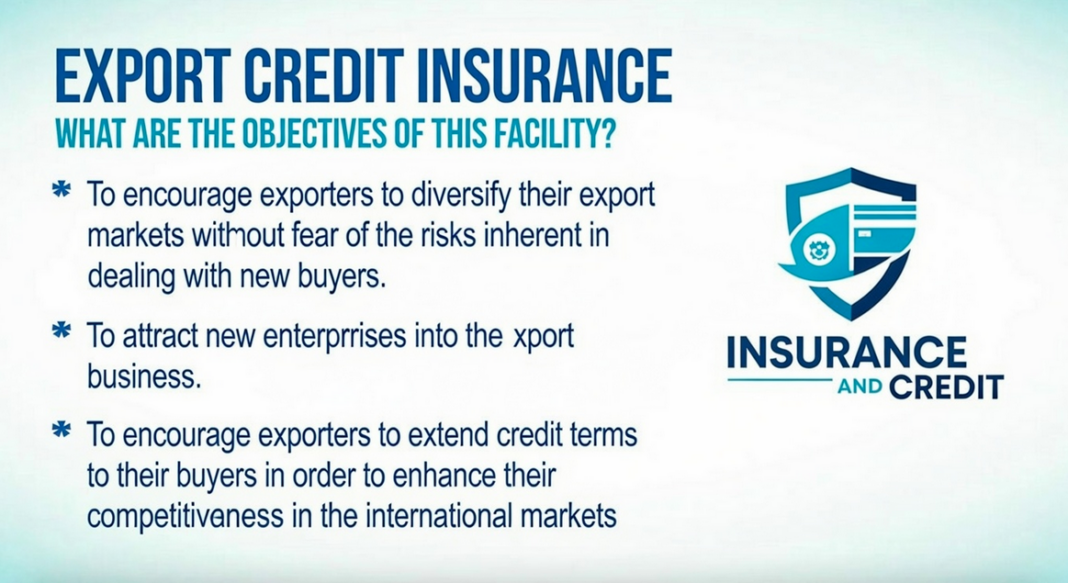

Export Credit Insurance (ECI) is a specialized risk-management tool designed to protect exporters, suppliers, and financiers against the non-payment of commercial debts arising from international trade transactions. In an increasingly globalized economy, where cross-border trade accounts for trillions of dollars annually, ECI serves as a critical safeguard that enables businesses to expand into new markets with confidence.
Unlike standard property or liability insurance, ECI specifically addresses the unique risks of international commerce, such as buyer insolvency, protracted default, political upheaval, currency inconvertibility, and expropriation.
The global export credit insurance market was valued at approximately $68 billion in 2025 and is projected to reach $95 billion by 2030, driven by rising trade volumes, supply-chain disruptions from geopolitical tensions, and the growth of small and medium-sized enterprises (SMEs) entering foreign markets.
For developing economies like Nigeria, where non-oil exports reached $5.8 billion in 2025 (primarily cocoa, sesame, and cashew), ECI can be transformative, helping local firms mitigate the high risks associated with buyers in Europe, Asia, and the Americas.
This publication provides full details about Export Credit Insurance. Its definition and mechanics, detailed coverage options, who needs it (both for business and home/personal use), costs and premiums, application processes, global and Nigerian providers, benefits and limitations, real-world case studies, regulatory frameworks, practical tips, frequently asked questions, and strategic advice for maximizing its value. Whether you are an exporter, importer, financier, policymaker, or individual entrepreneur, this guide equips you with actionable insights to navigate international trade securely. Meanwhile, you can firstly read about al the Facts on Insurance and see all the things to know on Insurance and its services.
History and Evolution of Export Credit Insurance
The origins of modern export credit insurance trace back to the late 19th and early 20th centuries, when European nations sought to stimulate overseas trade amid industrialization. The world’s first state-backed export credit agency (ECA) was established in 1919 by the United Kingdom as the Export Credits Guarantee Department (ECGD), now known as UK Export Finance. This was followed by similar institutions in Belgium (1919), the Netherlands (1923), and Germany (1926).
The Great Depression (1929–1939) exposed the vulnerabilities of unsecured trade finance, prompting the formation of the Berne Union in 1934—an international association of public and private ECAs that today represents over 80 members covering $2.5 trillion in annual transactions. Post-World War II, the Marshall Plan and the establishment of multilateral institutions like the World Bank and IMF further institutionalized export credit as a tool for economic reconstruction and development.
In the 1970s and 1980s, the rise of OPEC oil shocks and debt crises in Latin America and Africa highlighted the need for political risk coverage. The 1990s saw privatization trends, with private insurers like Euler Hermes (now Allianz Trade) and Coface expanding globally. The 2008 financial crisis and the COVID-19 pandemic (2020–2022) accelerated innovation, including digital platforms for instant quotes and parametric policies triggered by events like pandemics or natural disasters.
Today, export credit insurance operates under frameworks like the OECD Arrangement on Officially Supported Export Credits (the “Arrangement”), which sets guidelines on premiums, repayment terms, and environmental standards to prevent subsidy races. For African nations, initiatives like the African Export-Import Bank (Afreximbank) and the African Trade Insurance Agency (ATI) have localized support since the 1990s.
What Is Export Credit Insurance?
Export Credit Insurance is a contract between an exporter (or financier) and an insurer that indemnifies the insured against losses resulting from a buyer’s failure to pay for goods or services delivered under a commercial contract. It is fundamentally a form of trade credit insurance tailored to international transactions, bridging the gap between the exporter’s need for security and the buyer’s desire for deferred payment terms (often 30–180 days or longer).
Export Credit Insurance Risks
Unlike domestic credit insurance, ECI must account for additional cross-border risks:
- Commercial Risks: Buyer insolvency (bankruptcy, liquidation), protracted default (failure to pay within an agreed period, typically 3–6 months after due date), or repudiation (unjustified refusal to accept goods).
- Political Risks: Government actions such as war, revolution, civil unrest, expropriation of assets, import/export license cancellation, currency transfer restrictions, or moratorium on foreign debt payments.
- Catastrophic Risks: In some policies, coverage extends to force majeure events like natural disasters, pandemics, or terrorism that prevent fulfillment.
Coverage percentages typically range from 80–95% for commercial risks and 90–100% for political risks, with the insured retaining a deductible (co-insurance) to encourage prudent risk management. Policies can be short-term (single transaction or up to 2 years), medium-term (2–7 years for capital goods), or long-term (over 7 years for large projects).
Categories of Export Credit Insurance providers
ECI is underwritten by three main categories of providers:
- Government-Backed ECAs: Such as US EXIM Bank, Euler Hermes (Germany), SACE (Italy), or in Africa, ATI and Afreximbank. These often offer competitive rates and higher coverage for strategic sectors.
- Private Insurers: Companies like Allianz Trade, Atradius, and Chubb provide flexible, market-driven policies, often with faster claims processing.
- Multilateral Agencies: The Multilateral Investment Guarantee Agency (MIGA) of the World Bank Group focuses on political risk in developing countries.
Premiums are calculated based on buyer creditworthiness (assessed via agencies like Dun & Bradstreet or local credit bureaus), country risk ratings (from OECD or BERI Index), transaction size, payment terms, and the exporter’s claims history. Rates typically range from 0.2% to 5% of the insured value, with higher premiums for riskier markets like parts of Africa or the Middle East.
Helpful Topics
- 5 Best Short Term Health Insurance Providers in the US with low Premium offers
- How Much is Mortgage Payments? Calculate using Interest rate, Taxes and Insurance
- Claims Processing Software | Management of Healthcare, Insurance, Employee
- Nigeria Revenue Service Tax Return: How the Reforms Play Out Across Nigerian Cities
- Benefits of Registering your Business Name with CAC (Corporate Affairs Commission)
What Does Export Credit Insurance Cover?
Export Credit Insurance provides tailored protection across various risk categories. A standard policy includes:
Commercial Risks
- Insolvency: Full or partial bankruptcy of the buyer, including court-ordered liquidation or administration.
- Protracted Default: Non-payment after an extended period (e.g., 180 days for goods, 360 days for services).
- Repudiation: Buyer refuses to accept conforming goods without justification, leading to loss.
Political Risks
- War and Civil Disturbance: Damage or disruption due to conflict, riots, or insurrection.
- Government Intervention: Arbitrary cancellation of import licenses, embargo, or seizure of goods.
- Currency Inconvertibility: Inability to convert local currency into hard currency (USD, EUR) for transfer abroad.
- Expropriation: Nationalization or confiscation of the buyer’s assets by the government.
Additional Coverages (Often Available as Add-Ons)
- Pre-Shipment Risk: Loss of costs incurred (e.g., raw materials, labor) if the contract is canceled before shipment due to buyer default or political events.
- Consignment Risk: Protection while goods are held on consignment abroad.
- Transit Risk: Loss or damage during international shipping (sometimes bundled with marine cargo insurance).
- Performance Bond Risk: Coverage against unfair calling of bonds issued to secure contracts.
- Catastrophe Cover: Parametric payouts for events like pandemics or earthquakes, triggered by predefined thresholds.
Exclusions commonly include:
- Non-payment due to the exporter’s own breach of contract.
- Losses from normal business risks (e.g., quality disputes handled by arbitration).
- Transactions with related parties (affiliates) unless disclosed.
- Credit extended beyond agreed terms without insurer approval.
Policies are often “named-buyer” (covering specific purchasers) or “whole-turnover” (covering all exports), with the latter offering broader protection at potentially lower rates per transaction.
Who Needs Export Credit Insurance?
For Businesses
Export Credit Insurance is essential for any company engaged in international trade, particularly:
- SMEs and First-Time Exporters: Lack the capital to absorb defaults; ECI enables offering open-account terms (60–90 days credit) that competitors demand.
- Manufacturers of Capital Goods: Heavy machinery, aircraft, or infrastructure projects involve long payment cycles (1–5 years) and high values ($1M+), making non-payment catastrophic.
- Commodity Exporters: Agricultural producers (cocoa, sesame) or miners face price volatility and buyer defaults in volatile markets.
- Service Providers: IT firms, engineering consultants, or logistics companies with milestone-based contracts.
- Financiers and Banks: Use ECI to securitize export receivables, improving liquidity and Basel III capital ratios.
In Nigeria, sectors like oil & gas services, agriculture, manufacturing, and fintech increasingly rely on ECI to access European and Asian markets.
For Individuals and Home Use
While primarily a business tool, individuals can benefit in niche scenarios:
- Freelance Exporters or E-Commerce Sellers: Nigerians selling on platforms like Etsy, Amazon, or Jumia to international buyers can insure high-value shipments (e.g., artisanal crafts, fashion) against non-payment.
- Home-Based Businesses: Small-scale manufacturers or dropshippers exporting via Alibaba or eBay.
- Personal Investments Abroad: Individuals financing overseas property or equipment can insure against political risks if structured as a commercial transaction.
- Diaspora Entrepreneurs: Nigerians abroad remitting goods or services home can use micro-policies for protection.
However, individuals typically access ECI through aggregators or micro-insurance products, as standalone policies require minimum turnover (often $100,000+ annually).
Benefits and Advantages of Export Credit Insurance
- Risk Mitigation: Transfers 80–95% of loss to the insurer, preserving cash flow.
- Enhanced Competitiveness: Allows offering longer credit terms, winning bids against uninsured competitors.
- Access to Finance: Banks accept insured receivables as collateral for working-capital loans at lower interest rates.
- Market Expansion: Encourages entry into high-risk countries (e.g., from Nigeria to DRC, Venezuela, or war-torn regions).
- Credit Assessment Support: Insurers provide free or subsidized buyer credit reports and country risk analysis.
- Claims Expertise: Professional handling of disputes, arbitration, and recovery efforts.
- Tax and Accounting Benefits: Premiums are often tax-deductible; insured losses reduce taxable income.
- Government Support: Many ECAs offer subsidies or guarantees, lowering effective costs.
For Nigerian businesses, ECI can increase export volumes by 20–30% according to Afreximbank studies, directly contributing to foreign exchange earnings and job creation.
Costs, Premiums, and Financial Considerations
Premiums vary widely:
- Short-Term Goods: 0.3–1.5% of invoice value.
- Medium-Term Capital Goods: 1.5–4% annualized.
- High-Risk Markets: Up to 8–12%.
Factors influencing cost:
- Buyer credit rating (AAA = lowest premium; speculative = highest).
- Country risk category (OECD classifies Nigeria as 5–6 out of 7).
- Payment terms (longer = higher risk).
- Exporter’s experience and claims history.
- Insured percentage and deductible level.
Additional costs:
- Application fees ($0–$500).
- Credit reports ($50–$300 per buyer).
- Policy administration fees (0.1–0.5%).
Financing options include government subsidies (e.g., ATI offers reduced rates for African exporters) and bundling with trade finance products. ROI is typically high: a $10,000 premium protecting $1 million in exports yields substantial savings if a claim occurs.
How to Obtain Export Credit Insurance: Step-by-Step Guide
- Assess Needs: Determine transaction volume, target markets, and risk tolerance.
- Gather Information: Compile export history, financial statements, buyer details, and contract samples.
- Choose Provider: Compare ECAs, private insurers, and multilateral agencies.
- Submit Application: Online portals (e.g., Allianz Trade, ATI) or brokers; provide details on shipments and buyers.
- Underwriting: Insurer assesses risks, may request site visits or audits.
- Policy Issuance: Receive terms, premiums, and coverage certificate.
- Declare Shipments: For whole-turnover policies, submit monthly declarations.
- Claims Process: Notify within 30–60 days of default; provide evidence (invoices, correspondence); insurer investigates and pays within 3–12 months.
In Nigeria, start with local brokers like Leadway Assurance or global partners like Allianz Trade Nigeria.
Key Providers Worldwide and in Nigeria/Africa
Global Leaders:
- Allianz Trade (formerly Euler Hermes) – 40% market share.
- Atradius (Netherlands).
- Coface (France).
- US EXIM Bank, SACE (Italy), Hermes (Germany).
African and Nigerian Providers:
- African Trade Insurance Agency (ATI) – Covers 15+ countries, including Nigeria.
- African Export-Import Bank (Afreximbank) – Offers ECI through its Africa Energy Bank initiative.
- Nigeria Export Credit Guarantee Insurance Corporation (NEXIM) – Government-backed, focuses on non-oil exports.
- Private: Leadway, AIICO, Cornerstone Insurance, and international brokers like Marsh or Aon.
Nigerian exporters can access ATI policies via the Nigerian Export Promotion Council (NEPC) or direct applications.
Risks, Limitations, and Common Pitfalls
Limitations:
- Deductibles (5–20%) mean partial self-insurance.
- Exclusions for exporter fault or quality disputes.
- Policy caps and waiting periods (e.g., 6 months for protracted default).
Pitfalls:
- Under-insuring shipments.
- Failing to declare all exports.
- Ignoring policy conditions (e.g., prompt notification).
Mitigation: Work with brokers, maintain robust contracts with dispute-resolution clauses, and diversify buyers.
Case Studies and Real-World Examples
- Nigerian Cocoa Exporter: A Lagos firm insured $2.4 million shipment to China; buyer defaulted due to insolvency. Claim paid 90% ($2.16M) within 5 months, saving the company from bankruptcy.
- German Machinery Supplier: Exported to Nigeria; political unrest delayed payment. Political risk cover paid 95% of €1.8M.
- US SME to Africa: Used EXIM insurance for $500K medical equipment; currency controls triggered claim of $450K.
Global Perspectives and Regulations
The OECD Arrangement sets minimum premium benchmarks and maximum repayment terms (e.g., 5 years for most goods). The Berne Union promotes best practices. In Africa, the AfCFTA (African Continental Free Trade Area) aims to reduce intra-African trade risks, complementing ECI.
Practical Tips for Maximizing Benefits
- Start small: Insure pilot shipments to test providers.
- Bundle with factoring or forfaiting for full financing.
- Use digital tools: Many insurers offer API integrations for real-time declarations.
- Negotiate: Larger exporters can secure lower rates or higher coverage.
- Stay compliant: Adhere to anti-bribery (FCPA/UK Bribery Act) and sanctions rules.
- Review annually: Adjust coverage as markets change.
For Nigerians: Leverage NEPC grants, Afreximbank lines, and NIN-linked verification to speed approvals.
Frequently Asked Questions (FAQs)
- Is ECI mandatory? No, but often required by banks for financed exports.
- Can individuals buy it? Yes, via micro-policies or aggregators for high-value personal exports.
- What if the buyer disputes the debt? Insurer typically waits for resolution; exporter must pursue remedies.
- How long does claims payment take? 3–12 months, depending on investigation complexity.
- Can ECI cover services? Yes, including consulting, software, and engineering.
- What about cryptocurrency payments? Emerging coverage available from private insurers.
Conclusion
Export Credit Insurance is an indispensable instrument for thriving in global trade, offering robust protection against an array of commercial and political risks. From SMEs expanding into new markets to large corporations managing multimillion-dollar projects, ECI provides the security needed to offer competitive credit terms without jeopardizing financial stability. For individuals and home-based entrepreneurs, targeted micro-policies open doors to international e-commerce and freelance opportunities.
Try your best get full understanding of coverage details, selecting the right provider, managing costs effectively, and avoiding common pitfalls, users can transform export risks into calculated opportunities. In Nigeria and across Africa, making use of local institutions like NEXIM, ATI, and Afreximbank alongside global players ensures accessible, tailored solutions. As trade volumes grow and risks evolve, staying informed and proactive with ECI will remain a cornerstone of successful international business strategy.
Whether you are just starting your export journey or scaling a mature operation, investing time in proper ECI structuring pays dividends in peace of mind, cash-flow preservation, and sustained growth.