

Nigeria entered a new fiscal chapter on January 1, 2026, as tax return bill (reforms) signed into law by President Bola Ahmed Tinubu formally took effect. For millions of Nigerians—salary earners, traders, entrepreneurs, and corporate bodies alike—the 2026 tax return season will be the first real test of a system the Federal Government says is designed to be fairer, simpler, and less punitive.
At the centre of these reforms is the Nigeria Revenue Service (NRS), the newly rebranded and expanded successor to the Federal Inland Revenue Service (FIRS). Although some Nigerians still casually refer to the process as an “IRS tax return,” borrowing from the American system, the correct authority is now the NRS, established under a new legal framework meant to unify and modernise tax administration nationwide.
Nigerian Tax Bills Signed into Law
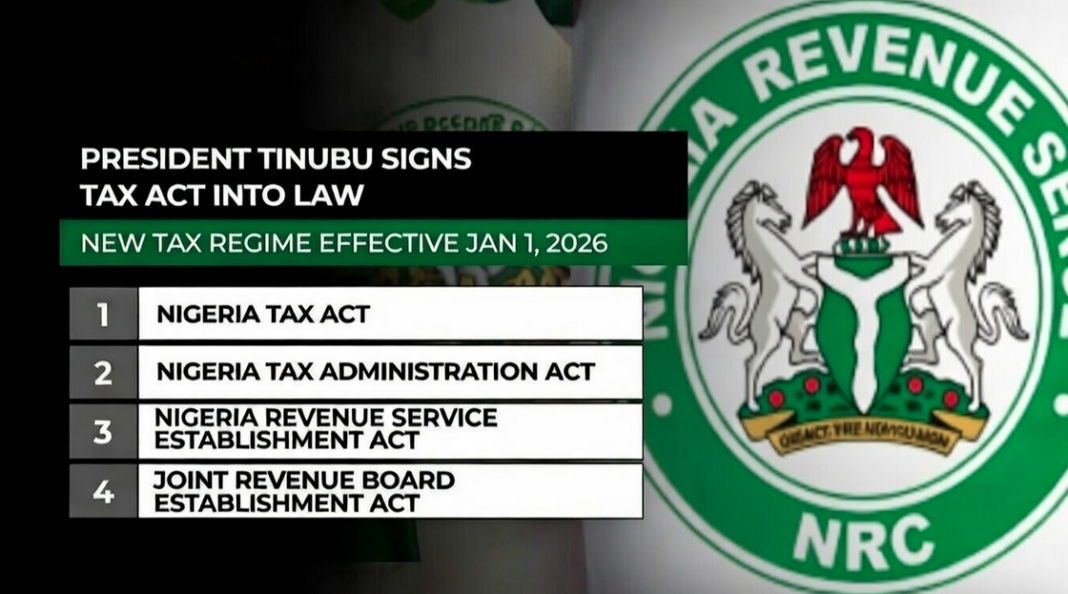
The reforms are anchored on four major tax laws signed on June 26, 2025, after months of consultation, controversy, and legislative bargaining. They are:
- the Nigeria Tax Act (NTA)
- the Nigeria Tax Administration Act (NTAA)
- the Nigeria Revenue Service Act (NRSA)
- the Joint Revenue Board Act (JRBA)
Together, these laws replace dozens of outdated statutes, collapse more than 60 overlapping taxes into fewer than 10, and attempt to address Nigeria’s long-standing dependence on oil revenue.
With Nigeria’s tax-to-GDP ratio hovering between 10 and 13 percent, far below the African average, the Tinubu administration insists the reforms are unavoidable. Critics, however, warn that poor implementation, inflationary pressures, and weak public trust could undermine the gains.
Why the Government Changed the Tax Return System
Nigeria’s tax problem is not new. For decades, government revenue has leaned heavily on crude oil exports, leaving public finances dangerously exposed to global price shocks. By 2023, when President Tinubu assumed office, the situation had become critical:
- public debt had crossed ₦87 trillion,
- debt servicing was consuming most government revenue,
- inflation surged above 25 percent,
- and more than 133 million Nigerians were living in multidimensional poverty.
In response, the President inaugurated the Presidential Fiscal Policy and Tax Reforms Committee in August 2023, chaired by tax expert Taiwo Oyedele. The committee’s mandate was clear: simplify taxation, expand the base, protect the people whose income is below the poverty threshold, people with low-income, and rebuild confidence in the system.
According to government projections, the reforms could raise non-oil revenue from about ₦15.2 trillion in 2025 to ₦18 trillion in 2026, if compliance improves.
A Brief History of Taxation in Nigeria
Nigeria’s tax system has always reflected power and politics. During colonial rule, taxes such as poll tax and hut tax were imposed mainly to fund imperial administration, sparking resistance, most notably the 1929 Aba Women’s Riot.
After independence in 1960, tax powers were shared between regions and the federal government. Military rule later centralised revenue collection, producing key laws such as the Companies Income Tax Act and the introduction of Value Added Tax (VAT) in the early 1990s.
The return to democracy in 1999 gave states more authority over personal income tax, but it also triggered chaos and multiple taxation, as local councils, states, and federal agencies imposed overlapping levies on the same businesses.
Previous reforms—such as VAIDS under President Buhari and the Finance Acts of 2019–2021—made progress, but fragmentation remained. The 2025 tax laws attempt, for the first time, to clean the slate entirely.
What the New Tax Laws Actually Changed
1. Nigeria Tax Act (NTA)
This law replaces major tax statutes and harmonises income taxes, VAT, capital gains tax, and development levies. Key provisions include:
- Exemption of personal income up to ₦800,000 annually
- Corporate Income Tax exemption for businesses with turnover below ₦25 million
- Gradual reduction of corporate tax for large firms from 30% to 25%
- Introduction of a 4% Development Levy, replacing multiple old levies
- Taxation of digital assets, crypto gains, and online services
2. Nigeria Tax Administration Act (NTAA)
This Act standardises procedures across the country:
- Mandatory electronic filing and payment
- Use of NIN or CAC numbers as Tax Identification Numbers
- Presumptive tax regimes for informal businesses
- Stronger penalties for evasion and late filing
3. Nigeria Revenue Service Act (NRSA)
The Act transforms NRS into a more autonomous agency, empowered to collect all federal revenues, enforce compliance, and deploy technology, including AI-based risk audits.
4. Joint Revenue Board Act (JRBA)
This law addresses a major complaint of Nigerian taxpayers: multiple taxation. It forces federal, state, and local governments to coordinate rates and eliminates overlapping levies, especially in markets and transport hubs.
What to Expect When Filing 2026 Tax Return
Salary Earners
- Anyone earning ₦800,000 or less annually pays no income tax
- New progressive rates apply to higher earners
- Rent relief and child education allowances are retained, though capped
- PAYE remains, but reconciliation is now digital
Traders and the Informal Sector
- Presumptive taxes simplify payments for artisans, market traders, and transport operators
- Local council levies are merged into harmonised state-federal taxes
- PoS operators must register formally from 2026
Businesses
- Small businesses (97% of registered firms) are exempt from CIT
- Medium firms pay 20%
- Large firms face reduced rates but broader tax bases
- R&D and export incentives are expanded
Digital Workers and Remote Professionals
- New rules define tax residency based on economic presence
- Freelancers earning from foreign platforms are now clearly taxable
Similar Taxation Updates
- The Role of The Attorney General in Taxation and Tax-Related Matters
- Tax implications on Cash-out Refinance for Homeowner rental property
- Legal Industry Adopts Cloud Computing for Solicitors & Law Firms
- Benefits of Registering your Business Name with CAC (Corporate Affairs Commission)
- Nigerian Tax Reform Bills (Acts) – Objectives, Impacts, Criticisms and Opinions
- Nigeria’s Tax System: Evolution, Reforms, Controversies, and the Tinubu Era
State Governments and the Federal Balance
One issue often missing from public debate is how the reforms affect state finances. While the federal government insists states will benefit from a broader base and reduced leakages, some governors worry about reduced autonomy.
VAT sharing remains contentious, especially between northern and southern states. The JRBA is expected to mediate disputes, but political tensions persist.
Public Backlash and Legal Questions about Tax Returns
Despite assurances, the reforms have faced resistance:
- Labour unions warn of indirect inflationary effects
- Student groups have staged protests
- Some lawmakers allege inconsistencies between passed and gazetted laws
- Opposition figures, including Peter Obi, have called for amendments
Tax experts have also raised concerns about capital gains taxation during high inflation, enforcement overreach, and data privacy under NIN-linked systems.
The NRS insists no new taxes were introduced and that over 60 percent of Nigerians are now legally tax-exempt.
What Taxpayers Should Do Now about their Tax Return
- Register or update tax details early
- Keep digital records of income and expenses
- Seek professional advice if operating across states or borders
- Monitor updates from NRS and state revenue services
How the New Tax Laws Play Out Across Major Nigerian Cities and SMEs
While the new tax laws are federal in nature, their real impact will be felt differently across Nigeria’s commercial and administrative centres. From Abuja’s civil service economy to Lagos’ business-driven environment, implementation will depend heavily on state revenue services, infrastructure, and taxpayer awareness.
Abuja: Civil Servants, Consultants, and Informal Clusters
As Nigeria’s capital, Abuja has a high concentration of federal workers, consultants, NGOs, and contractors. For many residents, the most immediate impact of the reforms is the higher personal income tax exemption of ₦800,000, which fully shields junior civil servants and minimum-wage earners from PAYE deductions.
However, Abuja also has a fast-growing informal economy—PoS operators, ride-hailing drivers, private tutors, and freelancers. Under the new laws:
- Many informal workers will now be captured through NIN-linked TINs
- Presumptive taxation replaces multiple levies previously imposed by area councils
- Contractors doing business with MDAs must ensure tax compliance, as direct deductions at source are now easier for NRS to enforce
The challenge in Abuja remains digital compliance, especially in satellite towns like Kubwa, Karu, and Lugbe, where internet access and tax education lag behind the city centre.
Lagos: Corporate Nigeria and the Compliance Test
In Lagos, Nigeria’s commercial nerve centre, the reforms represent both an opportunity and a stress test. With thousands of SMEs, multinationals, fintechs, and manufacturers, Lagos accounts for the largest share of non-oil tax revenue.
Key Lagos-specific implications include:
- Stronger collaboration between NRS and Lagaos State Internal Revenue Service (LIRS), reducing duplication of PAYE, WHT, and consumption taxes
- Tech startups and digital platforms face clearer rules on economic presence, especially those earning from non-resident clients
- SMEs benefit from the ₦25 million turnover exemption, though many must now formalise through CAC registration to qualify
For large corporations headquartered in Lagos, the gradual reduction of corporate income tax is offset by broader compliance scrutiny, especially around transfer pricing, digital services, and capital gains.
Kano: Traders, Manufacturers, and Market Levies
In Kano, Nigeria’s historic trading and manufacturing hub, the reforms could significantly alter how taxes are collected in markets and industrial clusters.
Under the new framework:
- Multiple market levies imposed by local governments are consolidated under harmonised rates supervised by the Joint Revenue Board
- Small traders benefit from presumptive taxes, reducing harassment by revenue agents
- Local manufacturers gain from VAT exemptions on key agricultural and production inputs
However, resistance remains strong among traders’ associations, many of whom distrust federal tax authorities due to past experiences of double taxation. Effective implementation in Kano will depend heavily on state-level sensitisation and cooperation with traditional market unions.
Port Harcourt: Oil, Services, and Environmental Compliance
In Port Harcourt and the wider Niger Delta, taxation is closely tied to the oil and gas sector. The new tax laws tighten reporting standards for upstream petroleum companies, especially around cost deductions and environmental obligations.
Key local effects include:
- Clearer separation between petroleum profits tax and general corporate tax
- Increased scrutiny of oil servicing companies and logistics firms
- New alignment with global standards on emissions-related levies
For residents, the expectation is that higher revenue collection should translate into improved infrastructure and environmental remediation—an issue that remains politically sensitive in the region.
SMEs Nationwide: Relief with Responsibility
Perhaps the biggest winners on paper are Small and Medium Enterprises (SMEs) across Nigeria. According to government estimates, 97 percent of registered businesses are now exempt from corporate income tax.
However, this exemption comes with conditions:
- Businesses must be properly registered with CAC
- Turnover must be accurately reported
- VAT and withholding obligations still apply where relevant
For many SMEs, especially in retail, hospitality, and logistics, the shift to fully digital tax filing is both a relief and a burden. While it reduces physical harassment by tax officials, it requires basic accounting skills and internet access.
What This Means in Practice
Across Abuja, Lagos, Kano, Port Harcourt, and other urban centres, the success of the 2026 tax regime will depend less on the law itself and more on:
- taxpayer education,
- coordination between federal and state authorities,
- and visible use of tax revenue for public services.
For SMEs and individual taxpayers, the message is consistent nationwide: formalisation now comes with real incentives, but non-compliance is increasingly difficult to hide.
What does the Future Hold for Tax Return Law?
If properly implemented, the reforms could lift Nigeria’s tax-to-GDP ratio to 18 percent by 2030, providing stable funding for infrastructure, health, and education. But success will depend on transparency, fairness, and the government’s ability to convince citizens that taxes paid will translate into visible public value. For Nigerians filing returns in 2026, the message is clear: the rules have changed—and understanding them is no longer optional.