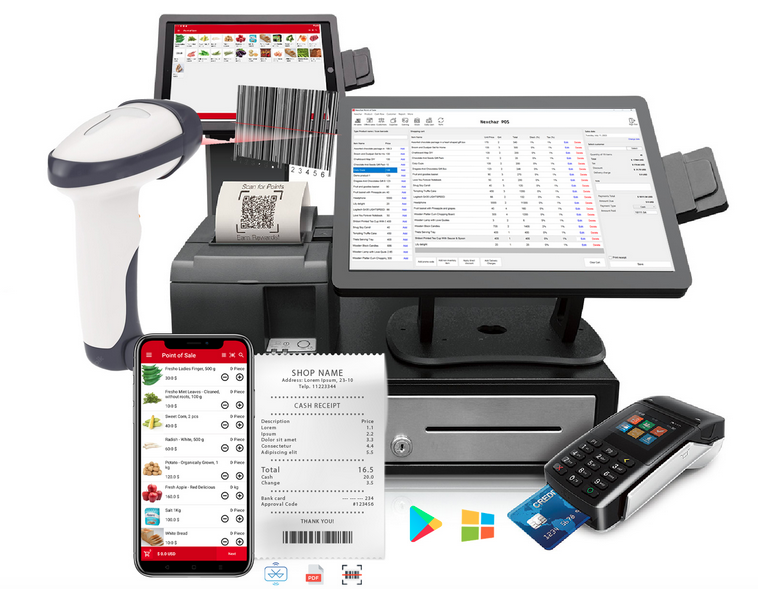

Here’s a practical, 2026-ready guide to choosing the right Point of Sale (POS) software — whether you’re a small shop, restaurant, service business, or multi-location retailer. A modern POS is far more than a cash register: it can be a central business engine that streamlines sales, inventory, customer management, analytics, and omnichannel operations.
Step-by-Step: How to Choose the Right Point of Sale (POS)
1. Know Your Business Needs
Start by identifying what your business actually needs from a POS:
- Type of business: Retail, restaurant, quick service, salon, grocery, etc.
- Sales environment: Counter checkout? Mobile sales? Online + in-store (omnichannel)?
- Transaction volume: High throughput or low daily sales?
- Hardware: Will you use tablets, dedicated POS terminals, kiosks, or mobile devices?
- Growth plans: Are you planning multiple locations or new channels later?
The right system for a single coffee cart is very different from what a multi-branch retailer needs.
2. Essential Features to Look For
A good POS in 2026 should offer more than just payment processing. Key capabilities to compare include:
Core Functionalities
- Fast, reliable transaction processing — minimal lag during peak hours.
- Inventory tracking — real-time stock levels, low-stock alerts, automated ordering.
- Multiple payment options — cash, credit/debit, contactless, digital wallets, etc.
- Reporting & analytics — daily sales, trends, employee performance dashboards.
Customer & Growth Features
- Customer database & loyalty — track preferences, launch promotions.
- CRM integration — connect purchase history to marketing tools.
- Omnichannel support — sync online and brick-and-mortar sales and inventory.
Usability & Flexibility
- User-friendly interface — easy for staff to learn and use.
- Mobile and cloud support — take payments on phones/tablets.
- Offline mode — process sales even without internet.
Security & Integration
- Secure payments & PCI compliance — protect customer data.
- Integrations with accounting, ERP, e-commerce, loyalty apps.
- User permissions & access controls — manage roles and sensitive functions.
3. Budget & Total Cost
Think beyond the advertised price. Evaluate:
- Software subscription vs. one-time license
- Transaction fees (especially for card payments)
- Hardware costs (receipts, scanners, tablets, registers)
- Add-on modules (loyalty, scheduling, ecommerce)
- Support & maintenance fees
Sometimes a seemingly “cheap” system ends up costing more after adding essential features and hardware.
4. Try Before You Buy
Most modern POS vendors offer:
✔ Free trials
✔ Demo sessions
✔ Onboarding support
Use these to test:
- How quickly staff can learn and use it
- Whether it fits your typical sales flow
- How easy inventory, reporting, and integrations work
👉 Trial periods are one of the best ways to avoid buyer’s remorse.
5. Support & Reliability
A POS is mission-critical, so choose a provider that offers:
- 24/7 support (or extended local hours)
- Automatic updates
- Active product development
- Strong documentation and tutorials
⚠️ Don’t choose purely on price if the vendor’s support is minimal — when problems strike, you want reliable help.
6. Plan for Future Growth
Consider how your needs might change:
- Adding more locations?
- Opening an online store?
- Implementing loyalty programs?
- Integrating accounting/ERP?
Choose a system that can scale with you — don’t lock into something that fits only your current size.
Quick Evaluation Checklist for Point of Sale Machines
| Category | Questions to Answer |
|---|---|
| Business Fit | Does it support your business type (retail/restaurant/etc.)? |
| Payments | Can it process all the payment methods your customers want? |
| Inventory | Does it track stock in real time and provide alerts? |
| Data & Analytics | Does it provide actionable reports? |
| Integrations | Will it integrate with your other tools (accounting, ecommerce)? |
| Support | Is customer support reliable and accessible? |
| Cost | What are all the upfront and ongoing costs? |
You must ask yourself some Quick questions (Just know the answers to these questions below):
- Your business type:
– Retail store (e.g., clothes, electronics)?
– Restaurant / café / bar?
– Service business (e.g., salon, repair)?
– Market stall / pop-up?
– Something else? - Where you sell:
– In-store only
– In-store + online
– Mobile/on the go - Monthly budget for POS software:
– Free only
– Up to $30/month
– $30–$100/month
– $100+ (more advanced) - Hardware you plan to use:
– iPad / tablet
– Mac / PC
– Dedicated register terminal
– Smartphone
What a POS (Point of Sale) System Is in 2026
A POS system is no longer just a cash register. In 2026, it typically combines:
- Sales & billing
- Cash + card + digital payments
- Inventory tracking
- Customer records
- Reports & analytics
- Optional online store integration
Most modern POS systems are cloud-based, work on Mac, Windows, tablets, or phones, and offer free starter plans with paid upgrades.
Free vs Premium POS Software (Quick Explanation for Point of Sale)
Free POS Point of Sale Apps
The Free plans usually include:
- Basic cash register & sales
- Product list
- Simple receipts
- Single store / single user
- Limited reports
Good for:
Small shops, startups, testing a business idea.
Examples we listed:
Square POS, Loyverse, Imonggo, eHopper, SumUp, Zettle
Premium POS Point of Sale Apps
Paid plans add:
- Advanced inventory management
- Multiple cash registers & users
- Employee tracking
- Customer loyalty programs
- Detailed reports
- Multi-location support
- Integrations (accounting, ecommerce)
Good for:
Growing businesses, busy stores, restaurants, chains.
Examples we listed:
Square Plus, Lightspeed, Clover, KORONA, Imonggo Premium
Cash Register Point of Sale (POS) Software (What They Do)
Cash register POS software replaces traditional registers and can:
- Record sales (cash & card)
- Print or send receipts
- Track daily income
- Reduce manual errors
- Store sales history
In 2026, even “cash registers” are usually apps running on tablets or computers.
Mac-Friendly POS Software
Most POS systems now work on Mac because they are:
- Web-based (run in a browser)
- iPad/iOS based (common with Macs)
- Cloud dashboards accessible from macOS
Mac-compatible examples:
Square POS, Imonggo, Loyverse, Hiboutik, OSPOS (open-source)
Open-Source POS (Free but Technical)
These are completely free but require setup:
- Self-hosting
- Basic technical knowledge
Good for:
Developers, IT-savvy users, custom solutions.
Examples:
uniCenta oPOS, Chromis POS, OSPOS
Related Articles
- Best Free & Premium Open Source POS Software
- Top Open Source POS (Point of Sale) Software
- Latest Free Retail Point of Sale (POS) Software
- 7 Top Free Grant Management Software
- 28 Church & Ministry Management Software Programs
- Top Rated Unified Security Management Software
- Software Development in the Cloud
How to Choose the Right POS (Point of Sale Summary)
When choosing a POS in 2026, focus on:
1. Business Fit
Retail, restaurant, service, or mobile business — each needs different features.
2. Features
Look for:
- Fast checkout
- Inventory tracking
- Reports
- Multiple payment methods
- Offline mode
3. Cost
Consider:
- Monthly fees
- Transaction fees
- Hardware costs
- Paid add-ons
4. Ease of Use
Staff should learn it quickly. A complex POS slows business.
5. Growth
Choose software you can start free and upgrade later.
Simple Recommendations
- Best free starter POS: Square POS, Loyverse
- Best for small retail: Imonggo, eHopper
- Best for payments + simplicity: Square, SumUp, Zettle
- Best for growing businesses: Clover, Lightspeed
- Best for tech users: uniCenta, OSPOS
Final Tips
- Start free
- Use cloud-based POS
- Upgrade only when you grow
- Avoid systems that lock you in too early
Therefore, you can:
✔ Start with the core features you must have and add optional ones as needed.
✔ Prioritize usability — a great feature set is worthless if staff avoid it.
✔ Choose cloud-enabled systems — they offer remote access, better uptime, and automatic updates.
✔ Always consider long-term costs and scalability.