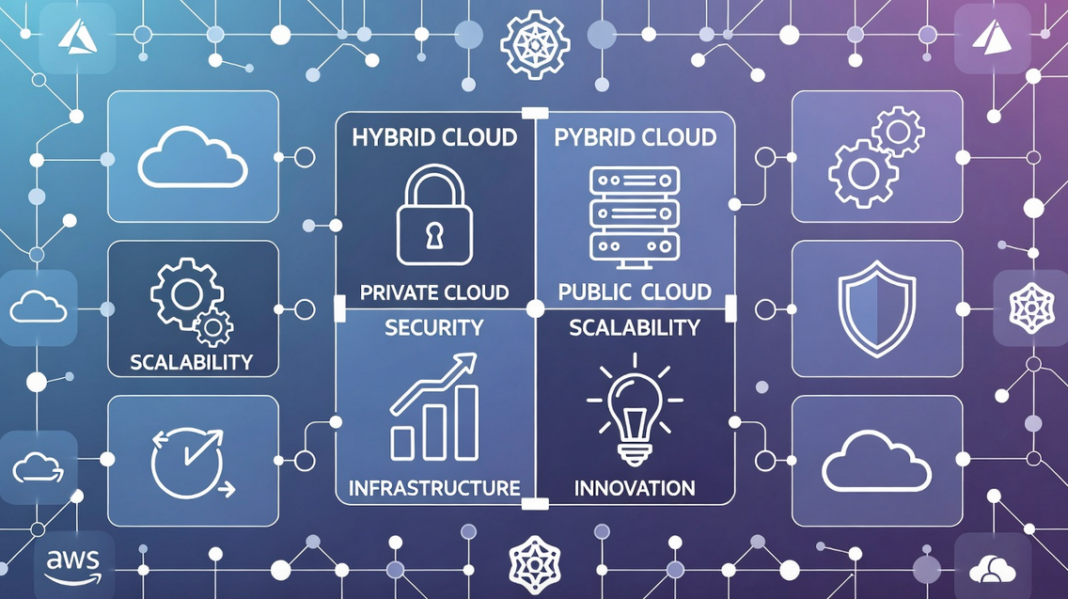

In the rapidly evolving landscape of information technology, hybrid cloud technology has emerged as a pivotal solution for organizations seeking flexibility, scalability, and cost-efficiency in their IT infrastructure. Hybrid cloud combines the best elements of private clouds (on-premises or dedicated) and public clouds (such as those offered by AWS, Azure, or Google Cloud), allowing seamless data and application portability between them. This approach addresses the limitations of relying solely on one type of cloud deployment, enabling businesses to optimize resources based on specific needs like security, compliance, and performance.
As digital transformation accelerates, hybrid cloud adoption has surged. According to industry reports, a significant portion of enterprises are now leveraging hybrid models to modernize their operations. This article delves into the intricacies of hybrid cloud technology, drawing from various online sources to provide a comprehensive overview, including its architecture, advantages, challenges, real-world applications, and future prospects.
What is Hybrid Cloud Technology?
Hybrid cloud refers to an integrated IT environment that interconnects private cloud services with public cloud resources, managed as a single entity. Unlike multi-cloud strategies, which involve using multiple public clouds without integration, hybrid cloud emphasizes interoperability and orchestration between on-premises infrastructure and off-site cloud services.
Key components include:
- Private Cloud: Typically hosted on-premises or in a dedicated data center, offering high control and security for sensitive workloads.
- Public Cloud: Scalable, pay-as-you-go resources from third-party providers, ideal for variable or high-demand applications.
- Integration Tools: Technologies like APIs, VPNs, and container orchestration platforms (e.g., Kubernetes) that enable data flow and workload migration.
The concept gained traction in the early 2010s as cloud computing matured. For instance, Gartner defines hybrid cloud as “a policy-based, orchestrated, service-oriented architecture that integrates on-premises and public cloud resources.” This integration allows organizations to burst workloads to the public cloud during peak times while keeping core data private.
From a technical standpoint, hybrid setups often rely on hypervisors like VMware or Hyper-V for virtualization, alongside cloud management platforms such as Red Hat OpenShift or Azure Arc for unified control. These tools facilitate automation, ensuring consistent policies across environments.
Benefits of Hybrid Cloud
Hybrid cloud offers numerous advantages that make it appealing for enterprises across sectors like finance, healthcare, and retail.
- Scalability and Flexibility: Organizations can scale resources dynamically without overhauling infrastructure. For example, during high-traffic events, applications can shift to public cloud for additional compute power, reducing costs compared to maintaining excess on-premises capacity.
- Cost Optimization: By using public cloud for non-sensitive, variable workloads and private cloud for steady, regulated ones, companies can minimize expenses. A study by Flexera indicates that hybrid cloud users report up to 20-30% savings in IT spending through optimized resource allocation.
- Enhanced Security and Compliance: Sensitive data remains on-premises, complying with regulations like GDPR or HIPAA, while leveraging public cloud’s advanced security features. Hybrid models support data encryption and access controls across boundaries.
- Improved Disaster Recovery: Redundancy across environments ensures business continuity. Tools like AWS Site Recovery or Azure Backup enable automated failover, reducing downtime.
- Innovation Acceleration: Developers can experiment in public clouds without disrupting core systems, fostering agile practices and faster time-to-market for new applications.
Overall, these benefits contribute to hybrid cloud’s projected market growth, expected to reach $145 billion by 2026, as per MarketsandMarkets research.
Challenges in Implementing Hybrid Cloud
Despite its advantages, hybrid cloud adoption is not without hurdles. Organizations must navigate complexities to realize its full potential.
- Integration Complexity: Connecting disparate systems can be technically challenging, requiring skilled IT teams. Incompatibilities between vendors may lead to “vendor lock-in” or integration failures.
- Security Risks: Data traversing between environments increases exposure to breaches. Proper implementation of zero-trust models and encryption is essential, but misconfigurations are common.
- Management Overhead: Overseeing hybrid setups demands robust monitoring tools. Without unified dashboards, visibility into performance and costs can suffer, leading to inefficiencies.
- Data Governance: Ensuring consistent policies for data sovereignty and latency management is critical, especially in global operations.
- Skill Gaps: Many organizations lack expertise in hybrid architectures, necessitating training or partnerships with managed service providers.
Addressing these challenges often involves adopting standards like those from the Cloud Native Computing Foundation (CNCF) to promote interoperability.
Key Technologies Enabling Hybrid Cloud
Several technologies underpin hybrid cloud deployments:
| Technology | Description | Key Providers |
|---|---|---|
| Containerization | Packages applications for portability across clouds using Docker and Kubernetes. | Google (Kubernetes), Docker Inc. |
| Orchestration Platforms | Automate deployment and scaling, e.g., Ansible, Terraform. | Red Hat, HashiCorp. |
| API Gateways | Facilitate secure communication between clouds. | AWS API Gateway, Azure API Management. |
| Edge Computing | Integrates with hybrid for low-latency processing. | IBM Edge, AWS Outposts. |
| AI/ML Integration | Enhances analytics across hybrid data sets. | Google Cloud AI, Azure Machine Learning. |
These tools evolve rapidly, with advancements in serverless computing (e.g., AWS Lambda) further blurring lines between cloud types.
Real-World Examples
Hybrid cloud is widely adopted by major corporations:
- Netflix: Uses AWS for streaming scalability while maintaining private data centers for content encoding and analytics.
- Capital One: Leverages hybrid for banking compliance, running core apps on-premises and customer-facing services on AWS.
- Siemens: Employs Azure hybrid solutions for IoT in manufacturing, combining on-site edge devices with cloud analytics.
These cases demonstrate how hybrid cloud supports diverse industries by balancing innovation with regulatory needs.
Future Trends in Hybrid Cloud
Looking ahead, hybrid cloud is poised for further innovation:
- AI-Driven Automation: Machine learning will optimize workload placement, predicting and automating migrations.
- Sustainability Focus: Green hybrid models will prioritize energy-efficient clouds, aligning with ESG goals.
- Quantum Integration: As quantum computing emerges, hybrid setups will incorporate it for complex simulations.
- Expanded Edge Hybrid: With 5G proliferation, edge-hybrid combinations will dominate IoT and real-time applications.
Analysts predict that by 2025, 90% of new operationalized apps will be deployed in hybrid environments.
How Companies Offer Hybrid Cloud Services to Clients
Hybrid cloud services are provided by major technology companies and specialized vendors through a combination of infrastructure, software, and managed services that integrate on-premises (private) environments with public cloud platforms. This allows clients to leverage the security and control of private clouds while benefiting from the scalability and cost-efficiency of public ones. Providers typically offer these services via subscription-based models, consulting, and deployment tools, enabling seamless data and application movement across environments. The process often begins with assessment and strategy planning, followed by implementation and ongoing management.
Key Ways Companies Offer Hybrid Cloud Services
Through Unified Management Platforms and Extensions:
- Providers extend their public cloud capabilities to on-premises infrastructure. For example, Microsoft Azure offers Azure Arc, which acts as a control plane to manage resources across on-premises data centers, edge locations, and even rival clouds like AWS or Google Cloud Platform (GCP), ensuring consistent governance, security, and application deployment.
- AWS provides AWS Outposts, which brings AWS hardware and software directly into clients’ data centers for a consistent operational experience, integrated with tools like AWS Systems Manager for monitoring and AWS Control Tower for governance.
- Google Cloud uses Anthos to manage containerized applications across on-premises, GCP, and other clouds, focusing on modernization and orchestration.
- IBM Cloud delivers IBM Cloud Satellite, which extends cloud services (including AI via watsonx) to client data centers or edges, supporting legacy system integration.
Managed Services and Consulting:
- Companies like DXC Technology partner with AWS, Google Cloud, Microsoft, and VMware to assist clients in hybrid transitions, offering strategy planning, application integration, cybersecurity assessments, and workload protection for over 800 customers.
- Rackspace connects workloads across public clouds (AWS, Azure) and private ones (VMware, OpenStack), providing multi-cloud management to maximize storage and efficiency.
- Vendors such as Dell Technologies (via Dell APEX) and HPE (GreenLake) offer consumption-based models where clients pay per use for infrastructure deployed in their own data centers or co-locations, simplifying operations across multi-vendor setups.
Specialized Tools for Security, Automation, and Optimization:
- Security-focused offerings include zero-trust frameworks, encryption, and AI-driven threat detection. For instance, Threat Stack provides real-time alerting and anomaly analysis for hybrid environments, aiding compliance.
- Automation tools like Turbonomic (from IBM) use AI to optimize performance, compliance, and resource usage through supply-and-demand data migration.
- Oracle’s Cloud@Customer deploys managed hardware (e.g., Exadata machines) on-site for local workload execution, addressing regulatory and latency needs.
- Cisco’s Intersight and Nutanix’s Cloud Platform enable unified monitoring, automation, and hyper-converged infrastructure (HCI) for hybrid multicloud operations.
Migration and Implementation Strategies:
- Providers guide clients through workload assessment, migration methods (e.g., lift-and-shift for quick moves or refactoring for optimization), and use cases like disaster recovery or cloud bursting to handle demand spikes. This includes tools like Kubernetes for container orchestration and open-source technologies for microservices.
Overall, these services are delivered as Infrastructure as a Service (IaaS) for core resources, Platform as a Service (PaaS) for development, or Software as a Service (SaaS) integrations, with emphasis on cost optimization, scalability, and compliance.
Types of Clients Targeted for Hybrid Cloud Services
Hybrid cloud providers target organizations that require a balance of control, compliance, and flexibility—often those with legacy systems, sensitive data, or variable workloads. These clients span various industries where full public cloud adoption may pose risks related to data sovereignty, security, or performance. Providers seek out enterprises that can benefit from cost savings during peaks, enhanced security for regulated data, and seamless integration without full migration.
Key Client Types and Industries
The following table summarizes common client types, their industries, and reasons for adopting hybrid cloud, based on real-world examples:
| Client Type/Industry | Examples | Reasons for Hybrid Cloud Adoption |
|---|---|---|
| Entertainment and Media | Netflix, Hulu, Dow Jones, Gannett, iQ Media, NEP Group | Handle bandwidth spikes (e.g., new releases) with on-demand scaling; store sensitive content privately while using public for backups and distribution. |
| Finance and Banking | JP Morgan, PWC, Global Stock Exchanges, Financial Services (Nasuni clients) | Compliance with regulations (e.g., GDPR, HIPAA); secure private servers for sensitive data alongside public for analytics and cost efficiency. |
| Healthcare and Life Sciences | Iora Health, National Cancer Institute, FDA, Life Sciences (Nasuni clients) | Data sovereignty for patient records; hybrid for compliant storage and AI-driven research in public clouds. |
| Government and Defense | State of Kansas, U.S. Air Force, NASA, Empower AI | High security for classified data; on-premises control with public bursting for computational needs like simulations. |
| Retail and E-Commerce | Target, Ulta, Carrefour, Six Flags, Under Armour, Yeti, Omaze | Manage seasonal demand spikes (e.g., holidays); integrate legacy systems with scalable public resources for inventory and customer data. |
| Manufacturing and Engineering | Siemens, Sonoco, Lockheed Martin, Engineering/Manufacturing (Nasuni clients) | Edge computing integration; private clouds for proprietary designs and public for supply chain analytics. |
| Transportation and Hospitality | Uber, Airbnb, Expedia, Travelodge | Scale during peaks (e.g., rush hours, events); cost-effective IT without over-provisioning servers. |
| Technology and Software | SproutSocial, Greenhouse, LogMeIn, Scality, Autodesk, Bitly, Clue, Samsung | Developer productivity with agile DevOps; hybrid for testing in public while securing core IP privately. |
| Energy and Other Regulated Sectors | Energy (Nasuni clients), Guinness Book of World Records | Compliance and data protection; hybrid for operational efficiency in volatile environments. |
Providers like AWS, Azure, and IBM actively target large enterprises (e.g., Fortune 250) and regulated industries, offering tailored solutions to address pain points like vendor lock-in, legacy modernization, and sustainability. Small to medium businesses are also increasingly targeted through simplified, pay-per-use models to accelerate growth without heavy upfront investments.
Conclusion
Hybrid cloud technology represents a strategic evolution in IT, offering a balanced approach to leverage the strengths of both private and public clouds. While it presents challenges in integration and security, the benefits in scalability, cost savings, and innovation far outweigh them for many organizations. As evidenced by industry leaders and market projections, hybrid cloud is not just a trend but a foundational element of modern digital infrastructure. Businesses considering adoption should assess their needs, invest in skilled resources, and partner with reliable providers to harness its full potential.