


The U.S. Fish and Wildlife Service has just published its report on the status of waterfowl population. This report is based on surveys conducted in May and early June, involving collaboration between the U.S. Fish and Wildlife Service, the Canadian Wildlife Service, and other partners. Total populations were estimated at 32.3 million.
North American Overall Trends
- A recent North American bird report reveals that duck populations, once a conservation success, have declined:
- –20% since 2014
- –30% since 2017 for dabbling and diving ducks AP News.
- In addition, over one-third of bird species across the continent are now categorized as being of high or moderate concern, signaling widespread conservation challenges Manistee News.
Regional Breeding Surveys (Spring 2025)
Prairie Pothole Region & Boreal Areas
- Survey teams reported widespread dry and smoky conditions across key breeding grounds in the prairies and southern boreal forests.
- Wetlands in these areas were sparse, and much of the habitat improvement from late rains came too late to support nesting ducks.
Dakotas
- Extremely dry winter and spring led to poor waterfowl production, with only the coteau regions showing marginally better—but still reduced—bird numbers such as scaup, mallards, ring-necked ducks, redheads, and pintails.
Montana & Southern Alberta
- Southern Montana faced drought-like conditions; eastern areas expected poor production, while western parts had fair output due to limited ponds
- In northern Montana, semi-permanent wetlands were mostly dry. Conditions improved north of Calgary, resulting in higher waterfowl densities there. However, southern Saskatchewan remained bleak, except around Allan Hills, showing some promise with 60–70% wetland water retention
North Dakota (Survey by NDGF)
- Estimated 2.66 million breeding ducks, down from 2.91 million in 2024 and 3.43 million in 2023.
- Still 7% above the long-term average, but populations—including mallards—are at historically low levels (mallards lowest since 1993 at –26%)
California (CDFW Spring Survey)
- Mallards rose from ~177,828 to ~265,640 (+49%).
- Total duck counts increased from ~373,864 to ~474,495 (+27%).
- Despite gains, mallard numbers remain ~16% below long-term average.
- Gadwalls soared over 100% above 2024 levels and are now ~28% above average.
- Cinnamon teal dropped 21% from 2024 and remain ~14% below average.
- Canada geese in northeastern regions rose 81% from 2024 and are now 43% above average
Washington & Oregon (Ducks Unlimited / state surveys)
- Washington: Total ducks virtually unchanged from 2024 (159,197), with declines in mallards (–11%) and gadwalls (–31%), but teals performed well:
- Green-winged teal +61%, cinnamon teal more than doubled
- Oregon: Total ducks at 267,222 (–11.5% from 2024). Mallards rose +12%, gadwalls down –10% but still above average; cinnamon teal +38%
Wisconsin (DNR Survey)
- Total breeding ducks were ~564,693 (+7% from 2024), about 27% above the long-term average.
- Mallards rose modestly by 2%, though still below long-term levels.
- Wood ducks slipped 1.8% but remained 5.1% above long-term.
- Canada geese declined 8% from 2024 but remain well above average
Wintering Waterfowl (Maryland)
- Mid-winter survey (Chesapeake Bay, etc.) recorded ~705,300 waterfowl in early January—significantly above 2024 (593,200) and the five-year average (624,300).
- Notable species increases:
- Dabbling ducks around 126,000 (vs. 91,300 in 2024).
- Mallards: ~62,300 (above 5-year avg of 54,740).
- Black ducks: ~47,600 (vs. avg 27,840).
- Canada geese: ~414,200 (higher than 350,500 in 2024 and ~354,760 avg)
Quick Updates
| Region/Category | Trend Summary |
|---|---|
| Prairies & Boreal | Widespread drought; production mostly poor |
| Dakotas & Montana | Below-average production in most areas |
| California | Strong increases in mallards and some other species |
| Washington/Oregon | Mixed: teals up, ducks stable or slightly down |
| Wisconsin | Overall strong growth, above long-term trends |
| Maryland (Winter) | Higher counts across ducks and geese compared to recent years |
| General Outlook | Long-term waterfowl declines: –20% since 2014, –30% since 2017 |
Waterfowl Population Survey 2023: Sea Ducks
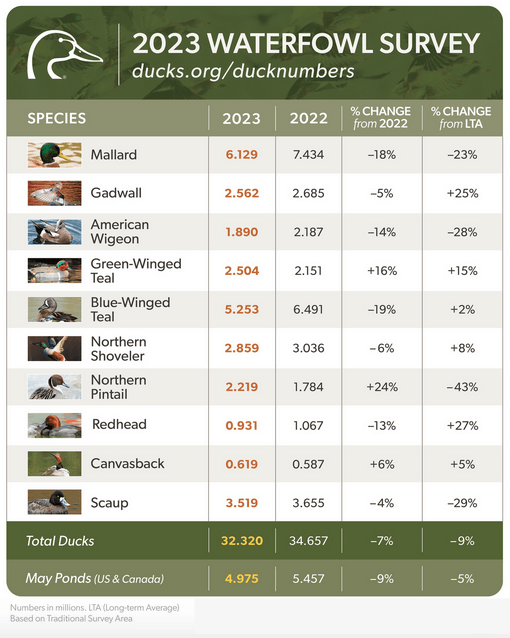
The report indicates that the total breeding duck population in the traditional survey area is estimated at 32.3 million, which reflects a 7% decrease from the 2022 estimate of 34.7 million. Furthermore, this figure is 9% below the long-term average since 1955.
Additionally, the report provides breeding population estimates for six common duck species groups in the Eastern Survey Area, which encompasses eastern Canada and northeastern states ranging from Virginia to Maine. The report also includes updates on the status of goose and swan populations.
Eastern Survey Area for Waterfowls Population

DU Chief Scientist Dr. Steve Adair explains that the current duck population numbers are the result of a complex interplay between waterfowl, weather, and habitat availability. Adair expressed some disappointment in these results, as there were hopes for better production in the prairies due to improved moisture conditions in the spring of this year.
However, last year’s nesting season was affected by delays caused by April snowstorms and heavy May rains, which likely had an impact on overall duck production. Adair also noted that population growth can be delayed as small, shallow wetlands recover from the long-term effects of severe drought.
Key Takeaways
The Waterfowl Population Status report reveals several key findings:
- Overall, duck populations are still healthy and close to their long-term averages, offering a promising outlook for waterfowl hunters and enthusiasts this fall and winter.
- Total pond numbers in the U.S. and Canada were estimated at 5 million, slightly below the long-term average, which could have implications for waterfowl habitat.
- Mallard and American wigeon populations have declined, with mallards down 18% and 23% from their long-term average, and American wigeon down 14% and 28% from their long-term average. These declines are a concern and highlight the need for ongoing conservation efforts.
- Pintail populations showed a notable increase of 24% compared to the record low from the previous year.
- The report emphasizes the importance of wetlands conservation, especially given the ongoing loss of habitat across North America.
- The impact of highly pathogenic avian influenza (HPAI) outbreak of duck populations is not expected to be significant based on reports from waterfowl managers and wildlife disease experts.
Ducks Unlimited CEO Adam Putnam stressed the importance of wetlands conservation and the need for sustained efforts to protect habitat and support healthy waterfowl populations.
You can access the full Waterfowl Population Status report from the U.S. Fish and Wildlife Service for more details.
What’s Next
The report explains ongoing concerns about habitat loss and degradation in the prairies, which have long-term impacts on the ability of waterfowl to breed, migrate, and winter successfully. Regardless of pond counts and precipitation, maintaining productive habitat throughout the waterfowl lifecycle is crucial.
Ducks Unlimited, along with partners like the U.S. Fish and Wildlife Service and various governmental, nonprofit, and corporate entities, has made significant strides in protecting and restoring waterfowl habitat. They have collectively conserved over 16 million acres of such habitat.
To further their understanding of waterfowl needs and conservation efforts, Ducks Unlimited continues to engage in innovative research projects. Additionally, private landowners, particularly farmers, play a vital role in maintaining healthy landscapes through voluntary incentive-based programs found in the U.S. Farm Bill.
Conservation efforts have yielded positive results over the decades. According to a recent State of the Birds report, waterfowl and other wetland-dependent bird species are the only group to have increased in numbers since the 1970s, largely due to these conservation initiatives.
Recognizing the need to invest in the future of wetlands and waterfowl populations, Ducks Unlimited, Ducks Unlimited Canada, Ducks Unlimited de Mexico, and Wetlands America Trust have launched “Conservation For a Continent,” a historic $3 billion capital campaign. This campaign represents one of the largest North American fundraising efforts aimed at supporting habitat protection and restoration.
Breeding duck numbers are highly variable across regions in 2025. The prairie regions are under stress from drought, while some western states like California and Wisconsin show encouraging gains. Yet, broader continental trends signal a concerning long-term decline—underscoring the urgent need for habitat conservation.
Article Source: Ducks.org
Related Posts to Duck Calling
- Top 7 Tactics for Calling Ducks When Hunting in the Woods for a Kill
- Eight Duck Calls Every Duck Hunter Must Master this Hunting Season
- How to Remove a Hickey in Seconds Using Toothpaste
- How to Effectively Increase your Brain Power to Boost Study
- 100 Best White NBA Players in Basket Ball History in Pictures
- Find Your Dream Job Here to Launch Your Career – Future starts
- How Many Grams is in a Pound? Converter Grams, Pounds & Ounce