The Moniepoint new POS terminal is showing its long-term enterprise strategy to overtake Opay and Palmpay with its new features for small business. In the finance and business news updates of the week, this information came up in the news. Therefore, as a small shop owner, trader, or manager, this article is an explanation of what is happening so that you can get the point quickly. But first, make sure you register your business with the Corporate Affairs Commission because there are several Benefits of Registering your Business Name with CAC as a business owner.
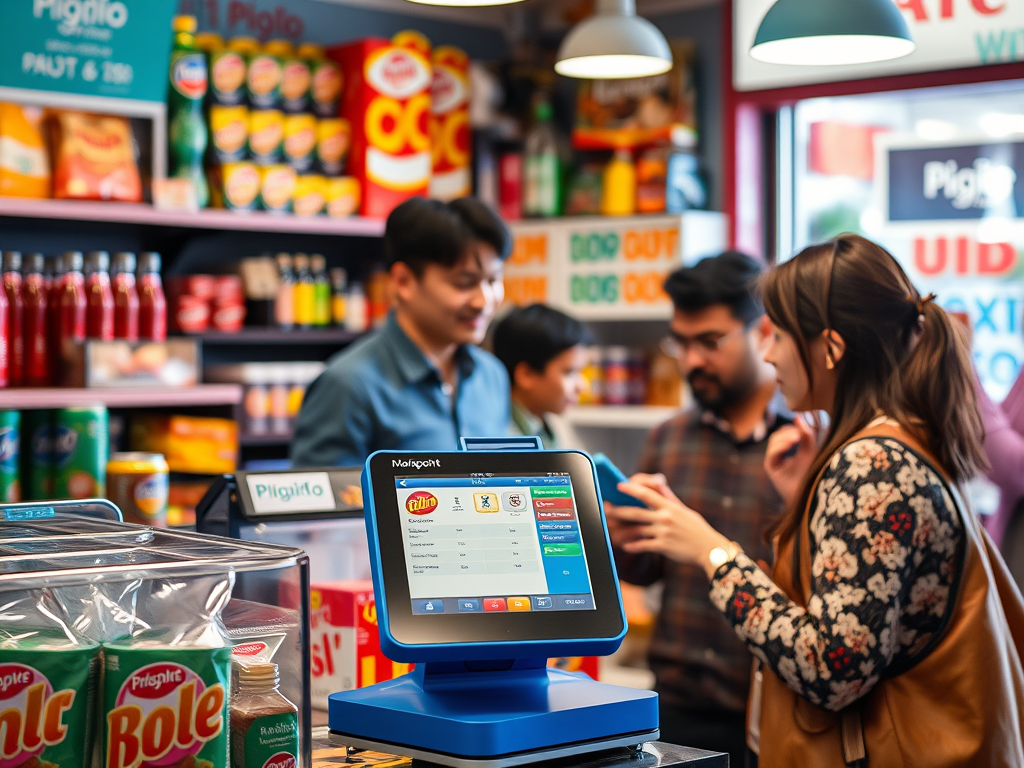
On August 7, I saw a new blue Moniepoint POS machine do something different. With just a few taps, it sold some biscuits and can of soft drink, collected the payment, reduced the stock, and printed both the receipt and invoice — all at once.
This is important because, in Nigeria, many shop owners face problems when it comes to balancing sales and payments. Often, a worker writes sales in a notebook or app, then collects payment on a POS. At the end of the day, the manager spends hours matching sales records with payment receipts. Mistakes, fraud, or missing money are very common.
Other companies like Orda, Mira, and OmniRetail have tried to fix this, but Moniepoint has now launched Moniebook — a new POS software that automatically joins sales, payments, and stock updates together.
Most of the POS machines in Nigeria — almost nine million of them — only process card payments. They don’t record what was sold. Moniebook changes that. It allows you to see your stock, payments, and reports instantly, without extra work.
Moniepoint Solution for Small Businesses
There are two types of solutions in the market:
- General software (like Moniebook): works for many kinds of businesses, easy to use, and fast to set up.
- Specialised software (like Orda or Mira): built for specific businesses like restaurants, with deeper features, but not as flexible.
What Moniepoint is doing to Ease Business Transactions
Moniepoint believes Moniebook is the easiest solution for most business owners. “A bookkeeping app alone can’t help if payments are separate,” said Babatunde Olofin, Managing Director at Moniepoint. “You need everything connected.”
During a test period, over 4,000 businesses used Moniebook. Restaurants processed hundreds of orders daily, supermarkets managed long checkout lines, roadside shops tracked stock, and even fuel stations logged every litre sold. Surprisingly, even a toll gate used it — treating cars like stock items (SUVs, buses, trucks). This gave the toll gate owner clear reports, like knowing exactly how many trucks passed in a month, something they had never tracked before.

How the Moniepoint POS works for Seamless Transactions
As a small business or shop owner, fuel station manager, supermarket or POS operator, its really important to know understand quickly how the Moniepoint POS system works without getting lost in its applications.
The Moniebook POS has two main parts:
- The back office dashboard – for owners and managers to set prices, manage stock, and view reports.
- The POS register – for cashiers and staff to sell items and collect payments.
On the dashboard, adding a new product is quick. You type in the name, category, price, barcode, and opening stock. Items can be:
- Standard (like biscuits or can drink),
- Variants (like T-shirts in different sizes and colours), or
- Bundles (like a Christmas hamper with different products).
For fuel stations, the POS can calculate litres from the money paid, so attendants don’t need to guess.
The POS also supports barcode scanning with its camera or an external scanner. If stock runs low, it automatically sends alerts. Every stock change is tracked, showing who made it and the before-and-after numbers.
On the register side, each cashier logs in with a personal PIN. Roles (like admin, accountant, or cashier) control what each person can do. This makes it easy to know who handled each sale. Once products are scanned or selected, the exact total is fixed — no one can type in a wrong amount or use a private POS to divert payments. “The common problems are cashiers typing the wrong amount, like ₦5,000 instead of ₦500, or using their own POS to collect money for themselves instead of the business.”
When payment is complete, the POS prints one slip that combines both the sales record and the payment receipt. At the same time, the dashboard updates instantly, showing the full details of the transaction: what was sold, staff who sold it, payment method, branch, and reference number.
Apart from sales, Moniebook also helps businesses by:
- Tracking expiry dates for perishable goods,
- Showing total stock value and expected profit,
- Allowing discounts for different customer groups,
- Giving detailed reports for businesses with many branches, and
- Working offline and syncing data when the internet is back.
Making “money” from Moniebook
Moniebook is not sold once and for all — it runs on a subscription.
- Core plan: ₦6,000/month for one POS and one shop. Extra shops cost ₦4,500 each, and extra POS devices ₦2,500 each.
- Pro plan: ₦8,500/month, with extra shops at ₦5,500.
Moniepoint does not sell its POS machines; it leases them out. This way, small business owners don’t need to spend hundreds of thousands upfront. If you already use a Moniepoint POS, you can simply swap it for a Moniebook-enabled one, no need to buy new hardware. That’s a big difference from competitors like Mira, where the devices are expensive to buy, plus you still pay subscription and transaction fees.
As Adebiyi, Moniebook’s product head, explained:
“It’s affordable for everyone — from single shop owners to big businesses with many branches.”
Moniepoint Banking Wallet is More than just POS Service
Moniepoint is aiming higher than just subscriptions. The company wants 100,000 merchants using Moniebook by year-end, but the real goal is to boost its lending business, which already makes up about 20% of its income.
Before now, Moniepoint gave loans based mainly on transaction records and sometimes by physically visiting a shop. With Moniebook, the company can now see real-time data:
- What you sell and how often,
- How fast stock moves,
- Your profit margins,
- Your busiest hours.
This data helps Moniepoint decide who qualifies for loans faster, reduces fraud, and gives regulators clear records. In the past, banks paid outsiders to prepare these reports — now Moniepoint’s system does it automatically.
Building Like a Startup
Since the beta launch, the Moniebook team has grown from 12 to 60 people. They work like a mini-company inside Moniepoint, with their own managers, engineers, designers, and support.
For Adebiyi (whose old company Grocel was acquired to help build Moniebook), joining Moniepoint made sense because, as he put it:
“To win with inventory systems in Nigeria, payments must be solved. Moniepoint had already solved payments.”
The Advantage of MoniePoint POS over Opay and Palmpay
Moniebook faces tough competition, but Moniepoint has a strong edge: its huge POS network already spread across Nigeria. This makes it easy to roll out Moniebook quickly. The more a merchant uses Moniebook — for payments, stock, reports, and loans — the harder it becomes to switch to another provider later.
At the end of the day, though, the real winners are small businesses. As Moniepoint’s media manager Bemigho Awala said:
“It’s about progress, not just for the company, but for mom-and-pop shops, supermarkets, and all the businesses that rely on us.”
If Moniebook spreads like Moniepoint’s normal POS machines, then the sound of receipts printing could soon be the new “background music” of Nigerian business.
Financial Updates You May Like
- Prices of New & Fairly Used Keke NAPEP Tricycle in Nigeria – Second Hand Tokumbo
- What are the Operating Hours of the Nearest Grocery Store for Late Night Shopping?
- How to Negotiate Debt Settlement with your Credit Card Company