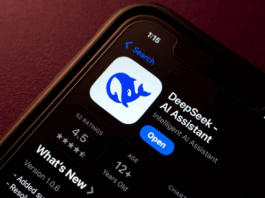
DeepSeek, a rising Chinese artificial intelligence startup, has affected both the tech industry and financial markets after its app soared to the top of global download charts. DeepSeek is trending as the Chinese AI app reducing US Tech Stocks and Nvidia Chipset market value.
In January, the company unveiled DeepSeek R1, a model positioned as a direct rival to OpenAI’s ChatGPT. What stunned the industry was not just its performance but the fact that it was developed at a fraction of the cost of American competitors.
DeepSeek Effect: The Chinese AI App That Rattled Nvidia and U.S. Giants
The sudden success sparked turbulence on Wall Street in the US. Nvidia, the world’s leading AI chip maker, saw billions wiped from its market value, while other major U.S. tech stocks also tumbled. The development has forced investors and policymakers alike to reconsider the assumption that the United States would inevitably dominate the future of artificial intelligence.
Even President Donald Trump weighed in, calling DeepSeek’s breakthrough a “wake-up call” for American companies.
DeepSeek, a Chinese AI startup, has gotten global attention after its app quickly climbed the download charts, even beating ChatGPT for a short time.
In January, the company released DeepSeek R1, an AI model that competes with OpenAI’s ChatGPT. What surprised everyone was that it was made for much less money—around $5.6 million—compared to the hundreds of millions usually spent by U.S. tech giants. The model is also open-source, meaning anyone around the world can use it, test it, and build on it.
The app’s success caused a big shake-up on Wall Street. Nvidia, the top AI chipmaker, lost billions in value, and other big U.S. tech companies like Meta and Google also saw their stock prices drop. This made investors and analysts rethink whether the U.S. will continue to dominate the AI field.
Even President Donald Trump called DeepSeek’s rise a “wake-up call” for American companies. Experts say this could push U.S. firms to rethink how much they spend and how they compete in AI.
What It Means for the World at Large
- Europe: Shows that powerful AI can be made without huge budgets, giving European companies a chance to catch up.
- Asia (outside China): Countries like India, Japan, and Singapore can use open-source AI to improve healthcare, education, finance, and other industries.
- Africa: Affordable, open AI like DeepSeek could help African countries improve farming, banking, education, and public services without needing expensive infrastructure.
In short, DeepSeek isn’t just shaking up U.S. tech—it could change how AI is used and shared around the world, giving more countries access to advanced technology.
What is Artificial Intelligence?
Artificial Intelligence (AI) is the branch of computer science that focuses on creating machines or software that can perform tasks that normally require human intelligence. Full details about Artificial Intelligence AI – Meaning, Benefits, Types, Movie, Future is available. The AI tasks include things like:
- Learning from data (e.g., recognizing patterns or making predictions)
- Reasoning and problem-solving (e.g., planning or decision-making)
- Understanding language (e.g., translating or chatting with humans)
- Perceiving the environment (e.g., seeing objects in images or hearing sounds)
In simple terms, AI allows computers to think, learn, and act in ways similar to humans, often helping people perform tasks faster, more efficiently, or more accurately. You can take a look at How to learn Artificial Intelligence for Free [7 Steps].
For example:
- Virtual assistants like Siri or Alexa
- Recommendation systems on Netflix or YouTube
- Self-driving cars
- Chatbots like ChatGPT
AI can be narrow (focused on specific tasks) or general (able to perform a wide range of intellectual tasks, like a human). Take a look at 6 Possible means Businesses can Profit from Artificial Intelligence.
Understanding Artificial Intelligence in the Real World
For you to easily understand why DeepSeek has caused such a stir, it helps to first look at what artificial intelligence (AI) does. At its core, AI allows a computer to learn, think, and solve problems in ways that can feel human.
AI systems are trained on massive amounts of data, learning patterns so they can make predictions, answer questions, or even carry on conversations. For example, they can suggest what you might want to buy online or chat with you like a real person.
In recent years, AI has become best known for powering chatbots like ChatGPT and DeepSeek, a type of AI called generative AI. These programs learn from huge collections of text, images, and other data so they can create new content, such as writing articles, summarizing text, or even generating images.
But AI isn’t perfect. It can sometimes produce false information and may repeat biases that exist in the data it was trained on.
Despite these challenges, millions of people now use AI tools every day—for example, to write emails, summarize reports, answer questions, learn coding, or study for exams. DeepSeek is part of this wave of AI, showing how these technologies are spreading and becoming more powerful worldwide.
What is DeepSeek Artificial Intelligence? China’s Free AI Chatbot Competing with ChatGPT
DeepSeek is a free AI-powered chatbot that works much like ChatGPT. People use it for similar tasks, from answering questions to helping with math and coding, though exactly how it compares to rivals is still debated.
The latest model, R1, is reportedly as capable as OpenAI’s o1 model, especially in reasoning tasks. Like o1, R1 is a “reasoning” model, meaning it builds responses step by step, simulating how humans think through problems or ideas.
One of DeepSeek’s most remarkable achievements is its low cost. Researchers say training R1 cost only about $6 million (£4.8m), far less than the “over $100 million” OpenAI reportedly spent on GPT-4. It also appears to have worked around U.S. export restrictions on the most advanced AI chips. The founder reportedly stockpiled Nvidia A100 chips (banned from export to China since 2022) and combined them with cheaper, less advanced chips to create a more efficient system.
R1 also uses less memory than its competitors, which lowers the cost for users. This mix of strong performance and affordability helped DeepSeek’s AI assistant become the most-downloaded free app on Apple’s App Store in the U.S. immediately after its release. On the same day, the app faced large-scale cyberattacks, forcing the company to temporarily limit new registrations, and its website also experienced outages.
Like other Chinese AI models such as Baidu’s Ernie or ByteDance’s Doubao, DeepSeek is trained to avoid politically sensitive topics. For example, when asked about the Tiananmen Square events of June 4, 1989, the app did not provide any details, reflecting government censorship rules in China.
Who is Behind DeepSeek?
Liang Wenfeng, a graduate of Zhejiang University in electronic information engineering and computer science, founded DeepSeek in December 2023. Unlike many Silicon Valley AI entrepreneurs, Liang also has a strong background in finance. He leads the hedge fund High-Flyer, which uses AI to analyze financial data for investment decisions—a practice known as quantitative trading. In 2019, High-Flyer became China’s first quant hedge fund to raise over 100 billion yuan ($13 million).
Liang has stressed that China cannot remain a follower in AI. He told Silicon Valley that the surprise over DeepSeek’s capabilities comes from seeing a Chinese company innovate, not just imitate.
Global Impact and Concerns of Deepseek AI
DeepSeek’s rise has raised attention and some regulatory concerns internationally:
- Australia banned the app on government devices over national security worries.
- Italy blocked the app and restricted it from processing citizens’ personal data.
- Other countries have requested clarification on how DeepSeek handles data stored on Chinese servers.
Despite these challenges, DeepSeek shows that high-quality AI can be developed affordably, and its open-source approach allows emerging markets to access advanced AI tools. Europe, Asia, and Africa could all benefit from more accessible AI, using it for sectors like education, healthcare, finance, and agriculture, without needing the enormous budgets typical of U.S. tech giants.
Why DeepSeek Matters to Technology
DeepSeek demonstrates that:
- AI doesn’t always require billions of dollars to compete at a high level.
- Open-source models can accelerate global innovation.
- Emerging economies can leverage AI to solve local challenges.
- U.S. dominance in AI is no longer guaranteed; competition is intensifying.
DeepSeek is reshaping the global AI landscape—combining efficiency, accessibility, and innovation, while raising questions about regulation, privacy, and international competition.
Why U.S. Companies Like Nvidia Felt the Impact
DeepSeek’s breakthrough challenged the long-held idea that building top-tier AI requires massive budgets and the most advanced chips. This raised doubts about the future demand for high-performance AI hardware.
Wei Sun, a principal AI analyst at Counterpoint Research, explains: “DeepSeek has shown that cutting-edge AI models can be created with limited computing resources.” By contrast, companies like OpenAI, valued at $157 billion, are under pressure to prove they can maintain a technological lead and justify their huge spending without delivering proportionate results.
The market reaction was immediate. On January 27, DeepSeek’s low-cost achievement triggered a global sell-off in tech stocks, causing the Nasdaq to drop more than 3%, with chipmakers and data center companies taking the biggest hits.
Nvidia felt the brunt of the impact. Its stock fell 17% on Monday, briefly dropping the company from the world’s most valuable by market capitalization to third place, behind Apple and Microsoft. Its market value shrank from $3.5 trillion to $2.9 trillion, according to Forbes.
Part of the reason Nvidia and others were affected is that DeepSeek is privately owned. Investors cannot buy its stock directly, so the success of the AI startup created uncertainty about which companies would profit from next-generation AI.
In short, DeepSeek’s rise shook confidence in traditional AI investment models and reminded the world that innovation doesn’t always require the biggest budgets or the most expensive hardware.
How Has China Reacted to DeepSeek?
DeepSeek’s rapid rise is being seen as a major win for China, supporting the government’s goal of developing technology independently from the West. While the Communist Party has not officially commented, Chinese state media highlighted how Silicon Valley and Wall Street were unsettled by the app, describing it as “shaking” the U.S. stock market.
Marina Zhang, an associate professor at the University of Technology Sydney, notes that in China, DeepSeek’s success is celebrated as proof of the country’s growing tech capabilities and self-reliance. She says the company represents a new phase of innovation—sometimes called Innovation 2.0—driven by younger entrepreneurs creating homegrown technology leadership.
However, Zhang also cautions that this enthusiasm could encourage tech isolationism, where China focuses heavily on internal innovation while limiting cooperation with global partners.
In short, DeepSeek is seen in China as both a symbol of national technological achievement and a potential driver of a more independent, inward-looking tech strategy.
Helpful Resources
- AI Myths vs Reality of Artificial Intelligence and Machine Learning debunked
- Deepseek Artificial Intelligence (AI) Chinese Company that develop
- Benefits and Risks of AI – Artificial Intelligence – Disadvantages
- ChatGPT AI Chatbot – How to Use, Download, Signup and Login
- Finding Keywords that is easy to Rank to Increase Traffic
- Tips to Get Text from Image Automatically with AI
- ChatGPT Red Flags and Google Code Red Alerts
- Trying to use ChatGPT and Jasper Ai?